


Navigating HMRC Self Assessment Help in Scotland: A Stress-Free Guide (2026)

What if the arrival of January didn't bring that familiar knot of dread in your stomach? For many people, the thought of tax season feels like a heavy burden, especially when you're trying to figure out the specific rules that apply only to those living north of the border. If you've been searching for HMRC self assessment help Scotland, you aren't alone in feeling a little overwhelmed by the different tax bands and the constant worry of a surprise penalty.
It's completely natural to feel confused by the gap between Scottish and UK tax rates or to feel like you're losing precious hours trying to organise a mountain of receipts whilst trying to focus on your work. We believe that managing your finances should bring you peace of mind, not a headache. In this guide, we'll show you how to simplify your tax returns and maximise your savings for the 2026 tax year. You'll discover how the latest Scottish tax rates work and how using Xero can transform your bookkeeping from a chore into a quick, stress-free task that gives you back your time.
Table of Contents
Why HMRC Self-Assessment Can Feel Overwhelming for Scottish Taxpayers
Understanding the Differences: Scottish Income Tax vs the Rest of the UK
Using Modern Tools: How Xero Cloud Accounting Simplifies Your Scottish Tax Return
Key Deadlines and Record-Keeping: Staying on the Right Side of HMRC
Personalised Support: How McCreath Accountancy Relieves Your Tax Anxiety
Why HMRC Self-Assessment Can Feel Overwhelming for Scottish Taxpayers
Tax season often arrives with a heavy sense of dread that can weigh on even the most organised business owners. Whether you're running a busy shop in Glasgow or managing a consultancy from home, that looming deadline can feel like a shadow over your daily work. Many people start the year with the best intentions of staying on top of their paperwork, but life often gets in the way. Before you know it, January is approaching, and the pressure to get everything right starts to build. This emotional weight is real, and it's something we see frequently amongst the hard-working community in Scotland.
Choosing a "DIY" approach might seem like a way to save money, but it often leads to late-night stress and the constant worry that you've missed something important. There's a significant difference between simply filing a return to keep HMRC happy and strategically managing your finances to protect your hard-earned income. The UK tax system is complex, especially when you factor in the specific powers the Scottish Parliament has over our income tax rates. Without professional HMRC self assessment help Scotland, it's easy to feel lost in the technicalities, leading to errors that could result in frustrating penalties.
The Burden of Record-Keeping in the Digital Age
One of the biggest hurdles is the sheer volume of receipts and bank statements that pile up over twelve months. Searching for a lost invoice from last spring whilst trying to meet a filing deadline is a recipe for anxiety. We've found that many business owners in Renfrewshire struggle with unorganised records simply because they don't have a simple system in place. This is why we're such big fans of Xero. It's a modern tool that allows you to snap photos of receipts on your phone and link them directly to your bank transactions. Instead of a frantic search in January, you have a tidy, digital record that stays updated all year round.
Reclaiming Your Time for What Matters Most
Your business deserves your full attention, and your free time should be spent with family or pursuing your favourite hobbies. When you transfer the responsibility of your tax affairs to a trusted partner, you aren't just hiring an accountant; you're buying back your time. Residents in Linwood and Paisley often tell us that the greatest benefit is the peace of mind they feel. Knowing that experts are handling the HMRC correspondence and ensuring every legitimate saving is claimed allows you to breathe easier. We take care of the administrative chores so you can focus on the strategic growth of your business and the things that truly matter to you.
Understanding the Differences: Scottish Income Tax vs the Rest of the UK
Whilst HMRC is responsible for collecting the money, the Scottish Government has the power to decide exactly how much you pay based on your income. This can feel confusing if you're used to the standard UK rates. When you file your Self Assessment tax returns, HMRC uses your home address to determine which rates apply to you. If your main place of residence is in Scotland, you're a Scottish taxpayer. This means your tax code will likely start with an 'S', marking a clear difference from someone living in London or Cardiff.
The impact of these unique bands on your final bill is significant. Because the thresholds are different, your tax liability isn't calculated in the same way as the rest of the UK. Getting expert HMRC self assessment help Scotland ensures you don't fall foul of these specific rules. It's not just about paying the right amount; it's about having the confidence that your residency status is correctly reported. If you're unsure which category you fall into, seeking professional tax advice can clarify your position and prevent future headaches.
A Plain-Language Guide to Scottish Tax Bands
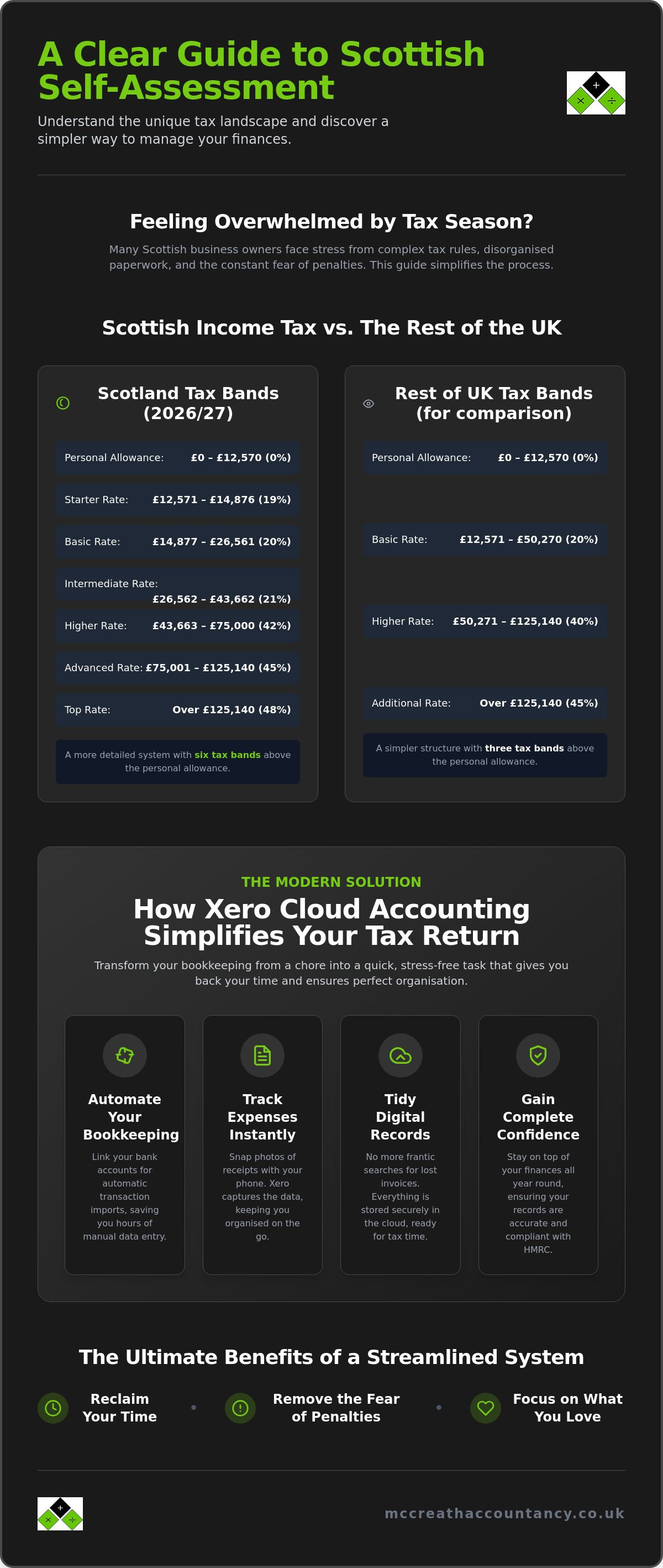
For the 2026/27 tax year, Scotland continues to use a more detailed system than the rest of the UK. After your standard Personal Allowance of £12,570, the rates begin at the 19% Starter Rate. This progresses through the 20% Basic Rate and the 21% Intermediate Rate. Higher earners face the 42% Higher Rate, the 45% Advanced Rate, and the 48% Top Rate for income over £125,140. These specific steps mean that your calculations require precision. Modern tools like Xero are incredibly helpful here, as they can be set up to recognise Scottish tax codes and calculate your obligations automatically throughout the year.
Common Misconceptions About Scottish Tax
A frequent worry is that living in Scotland always means paying more tax. This isn't necessarily true. In fact, for the 2026/27 year, it's estimated that approximately 57% of Scottish taxpayers will pay less than they would if they lived elsewhere in the UK. Your Personal Allowance still works in the same way, reducing your taxable income before the rates even kick in. The key to not overpaying is accurate reporting. By using a system that tracks your income in real-time, you can see exactly where you stand without waiting for a surprise bill in January.
Using Modern Tools: How Xero Cloud Accounting Simplifies Your Scottish Tax Return
Many small business owners across Scotland still find themselves buried under piles of paper once a year. However, the shift towards digital tax reporting means there is a much better way to manage your finances. We highly recommend Xero as the go-to cloud-based solution for our clients. It's designed to take the guesswork out of your bookkeeping, which is vital when dealing with Scottish income tax differences that can complicate your annual return. By adopting this modern platform, you're not just following a new rule; you're choosing a simpler, more efficient way to run your business.
One of the biggest advantages of using Xero is the ability to see your potential tax bill in real-time. Instead of waiting until January to find out how much you owe, you can log in at any time and see a clear estimate of your upcoming payment. This visibility provides incredible peace of mind because it allows you to set aside the correct amount of money each month. For our clients in the Western Isles, where reliable connectivity allows for seamless updates, Xero ensures that your financial data is always current and accessible from any device. When you seek HMRC self assessment help Scotland, our team will show you how to get the most out of these features to keep your business moving forward.
Learn how accountancy Glasgow helps you reclaim your time with professional financial support.
Automated Record-Keeping and Receipt Capture
Gone are the days of keeping shoeboxes full of faded receipts. With the Xero mobile app, you can simply snap a photo of a receipt as soon as you receive it. The software reads the information and matches it to your bank transactions automatically. Because Xero uses secure bank feeds, your bank statements flow directly into the system, which significantly reduces the need for manual data entry. This structured approach keeps your data safe in the cloud and ensures you never lose a legitimate business expense again, helping you stay organised all year round.
Collaboration Between You and Your Accountant
Xero isn't just a tool for you; it's a bridge between your business and our team. By sharing access to your live data, we can provide proactive tax advice throughout the year rather than just looking backwards at old figures. This partnership reduces the endless stream of emails during the Self-Assessment window. Most importantly, it ensures your records are always ready for Making Tax Digital (MTD) requirements, whilst ensuring your records are always transparent. When you have HMRC self assessment help Scotland from experts who use the same tools as you, the entire process becomes a simple conversation rather than a stressful event.
Key Deadlines and Record-Keeping: Staying on the Right Side of HMRC
Staying compliant with HMRC doesn't have to be a race against time. For sole traders and landlords across the country, the tax calendar has a few non-negotiable dates that require your attention. If you've been looking for HMRC self assessment help Scotland, the first step is marking the 31st of January in bold on your calendar. This is the final deadline for both filing your online return and paying the tax you owe for the 2025/26 tax year. Missing this by even a few minutes triggers an automatic £100 fine, which is a frustrating and completely avoidable expense.
By law, you're required to keep your business records for at least five years after the 31 January submission deadline. This mountain of paperwork includes P60s, bank statements, and every single expense receipt you've collected. Whilst this sounds like it would take up a lot of physical space, Xero allows you to digitise everything. You can store your records safely in the cloud, ensuring they're always available if HMRC ever asks to see them. Review our mistakes to avoid on self assessment tax return guide to see how poor record-keeping often leads to simple errors that catch people out.
The Step-by-Step Timeline for a Stress-Free January
Don't wait for the winter chill to start your tax preparations. If you're new to being self-employed, you must register for Self Assessment by 5 October 2026. By November, you should aim to have all your interest certificates and expense records organised. Our goal is always to help you file by December. Imagine enjoying your festive break knowing your tax is already handled. It's a level of freedom that our clients value deeply, as it removes the pressure that usually builds up at the start of the new year.
What Happens if You Miss the Deadline?
If life gets in the way and you miss the 31 January cutoff, the penalties start immediately. After that initial £100, daily fines of £10 kick in once you're three months late, which can reach a maximum of £900. HMRC does listen to "reasonable excuses", such as a serious illness or a death in the family, but they're generally quite strict. If you find yourself behind, the best thing you can do is contact an expert immediately. We can help you navigate the appeals process and get your affairs back in order quickly to mitigate any further damage.
Ready to stop worrying about dates? Get help with your tax returns today and let us handle the deadlines for you.
Personalised Support: How McCreath Accountancy Relieves Your Tax Anxiety
The transition from feeling overwhelmed by paperwork to feeling completely in control of your finances is a journey we take with every one of our clients. Whether you're based in the heart of Renfrewshire or operating a business in the Western Isles, our team is here to ensure that the weight of tax season never feels too heavy. We don't just see ourselves as accountants; we're your dependable partners in business. By choosing professional HMRC self assessment help Scotland, you're choosing to hand over the heavy lifting of registration and final submission to experts who care about your success as much as you do.
Having a local expert in places like Linwood or Stornoway provides a level of understanding that a faceless government website simply cannot match. We know the local landscape and the specific challenges Scottish business owners face. Our approach is rooted in long-term stability rather than a frantic, once-a-year rush to meet a deadline. We're here to provide a stabilizing force that allows you to breathe easier, knowing that your tax affairs are being handled with meticulous care and precision. This partnership is built on trust and the shared goal of reclaiming your time for what matters most.
Expert Tax Advice Tailored to Your Needs
Every business is unique, and your tax return should reflect that. We take the time to look closely at your records to identify legitimate expenses you might have missed, ensuring you aren't paying a penny more than you owe. From construction workers managing the complexities of the Construction Industry Scheme (CIS) to creative freelancers with irregular income streams, we provide strategic advice that fits your specific situation. Our focus is on making sure your finances are as efficient as possible, providing you with the peace of mind that comes from expert oversight.
Starting Your Journey Toward Financial Peace of Mind
Switching to a new way of working doesn't have to be complicated. We've designed our process to be as simple and welcoming as possible. When you join us, we'll get you set up on Xero, which we've found to be the most effective tool for keeping our clients organised and stress-free. This cloud-based platform allows us to collaborate with you in real-time, providing proactive support whenever you need it. It's about creating a system that works for you, not the other way around. We invite you to have a calm, professional conversation with us about your tax affairs. Let us take the burden off your shoulders so you can focus on your core passions and enjoy the rewards of your hard work.
Take the Next Step Toward a Simpler Tax Season
Mastering your finances is about more than just meeting a deadline; it's about creating a system that supports your lifestyle. By staying ahead of the 2026 deadlines and using Xero to automate your records, you can eliminate the January rush for good. This proactive approach ensures you're always prepared for the unique requirements of the Scottish tax system whilst keeping your data secure and organised.
Seeking professional HMRC self assessment help Scotland allows you to transfer the pressure of compliance to a partner you can trust. As a Xero Silver Partner with local offices in Linwood and Stornoway, we have the expertise to manage your specific tax nuances with ease. We're dedicated to providing the stability and meticulous detail your business needs to thrive, ensuring you never pay more than is necessary.
Let McCreath Accountancy handle your Self-Assessment so you can focus on what you love.
You've built something special through hard work and dedication. Let's work together to protect your progress and give you back the freedom to focus on your true passions.
Frequently Asked Questions
Do I pay different tax if I live in Scotland but work in England?
Yes, your tax rates are based on where you live rather than where you work. If your main home is in Scotland, you'll pay Scottish Income Tax even if your office is in London. HMRC uses your residential address to assign your tax code, which usually begins with an 'S' to ensure the correct rates are applied to your earnings.
How much is the penalty for a late Self-Assessment tax return in 2026?
You will receive an automatic £100 penalty if your return is even one day late after the 31 January deadline. If you still haven't filed after three months, HMRC adds a daily penalty of £10 for up to 90 days. This means your fines could reach £1,000 quite quickly, so it's always best to file early to avoid these unnecessary costs.
What is the "Starter Rate" of tax for Scottish residents?
The Starter Rate is a 19% tax bracket that applies to income between £12,571 and £16,537 for the 2026/27 tax year. It was designed to make the tax system fairer for lower earners in Scotland. Because this rate is lower than the basic rate in the rest of the UK, many Scottish taxpayers find they actually pay less than they would elsewhere.
Can I use Xero to file my Self-Assessment directly to HMRC?
Xero is a fully compliant tool that allows you to manage your records and file your tax information directly to HMRC. It's built to handle the requirements of Making Tax Digital (MTD), which becomes mandatory for many from April 2026. By using Xero, you can submit your quarterly updates and final declarations with just a few clicks, keeping your business compliant and organised.
What expenses can I claim as a sole trader in Scotland?
You can claim for any costs that are "wholly and exclusively" for your business, including things like stationery, work clothing, and heating for your home office. Getting HMRC self assessment help Scotland ensures you don't miss out on these legitimate savings. Xero helps you stay on top of this by letting you record expenses the moment they happen, so nothing gets forgotten.
Do I need to register for Self-Assessment if I earn less than £1,000?
You generally don't need to tell HMRC or pay tax if your gross income from self-employment is £1,000 or less in a tax year. This is known as the Trading Allowance. However, if your income is higher than this, or if you need to claim certain benefits or pay voluntary National Insurance, registering for Self Assessment is a necessary step to stay on the right side of the law.
How long do I need to keep my tax records for HMRC?
You are legally required to keep your business records for at least five years after the 31 January deadline of the relevant tax year. This includes all invoices, receipts, and bank statements. Storing these documents digitally in Xero is a brilliant way to save space and ensure your data is secure. It also makes it much easier to find specific information if HMRC ever asks questions.
Can an accountant help me if I have already missed the tax deadline?
An accountant can certainly help you submit a late return and work to minimise any further penalties or interest. If you've missed a deadline and feel overwhelmed, our team provides HMRC self assessment help Scotland to get your affairs back in order. We can look at your specific situation and help you communicate with HMRC, providing a stabilising force during a stressful time.



Comments