


How to Register for Self Assessment in Scotland: A Step-by-Step 2026 Guide
- McCreath Accountancy

- 2 days ago
- 12 min read
What if the most daunting part of your new professional journey isn't the work itself, but a looming deadline on 5 October? Many new business owners across Renfrewshire and the Western Isles feel a genuine sense of dread when they think about tax, especially with the unique Scottish income tax bands that begin at a 19% starter rate. We understand that the fear of making a mistake on official forms can feel heavy, but it doesn't have to be a burden you carry alone. If you are wondering how to register for self assessment Scotland, you are in the right place to find clarity and peace of mind.
We promise to help you master the HMRC registration process so you can manage your Scottish tax obligations with complete confidence. By following this guide, you'll learn exactly how to obtain your UTR number and understand your specific responsibilities under the Scottish tax system. We will also explore how using Xero cloud accounting software can simplify your ongoing bookkeeping, making it easier than ever to stay organised whilst you focus on what you love most about your business.
Table of Contents
Understanding Self Assessment: Why Registration is Different in Scotland
Self Assessment is the method HM Revenue and Customs (HMRC) uses to collect Income Tax on money that hasn't already been taxed at source, such as self-employed profits or rental income. For many people starting a new venture in Glasgow or the Western Isles, interacting with the UK Self Assessment system for the first time can feel like a significant hurdle. However, viewing registration as the foundation of your financial freedom allows you to take control of your future. Getting your status right from the beginning ensures you avoid unnecessary enquiries from HMRC later on, giving you the peace of mind to focus on your core passions.
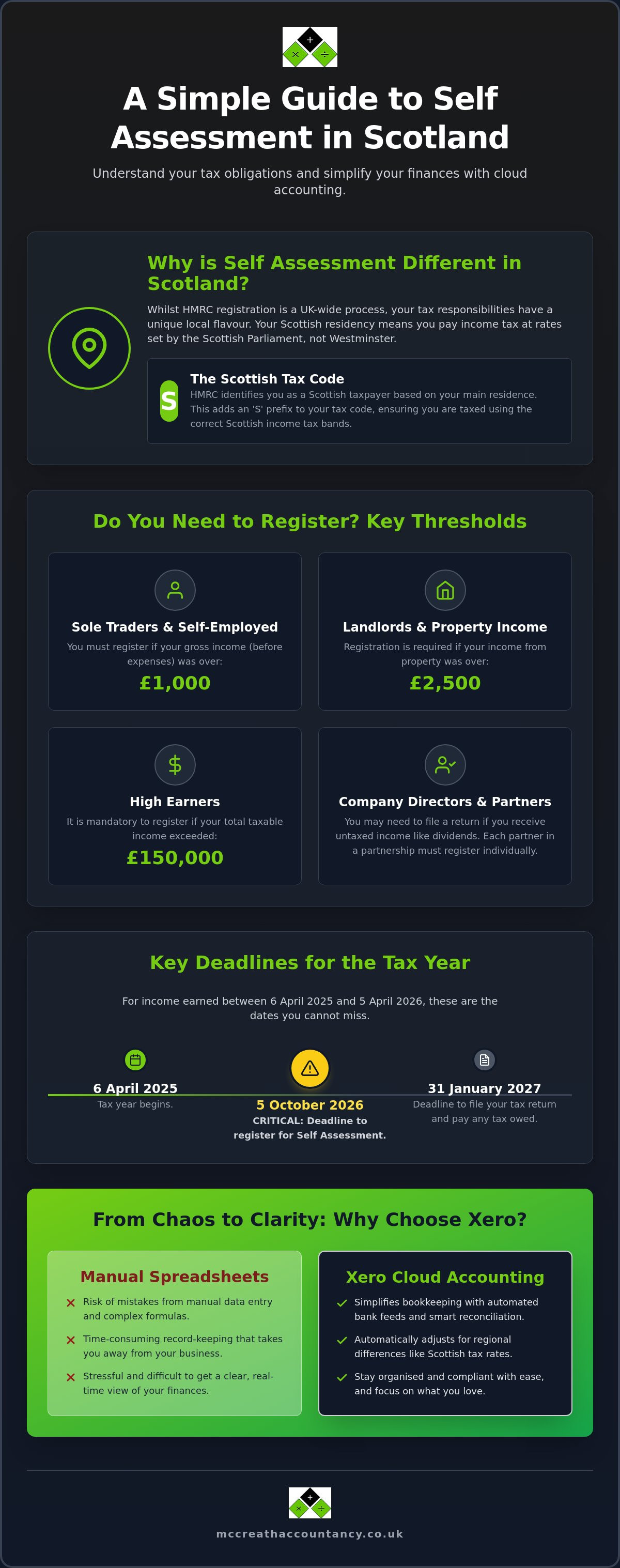
If you live north of the border, your tax journey has a unique local flavour. Whilst the registration process is handled by a UK-wide department, the rates you pay are decided by the Scottish Parliament. Learning how to register for self assessment Scotland is slightly different in context because your residential address triggers specific Scottish tax codes. This ensures you are taxed according to the specific bands that apply to residents here, rather than the rates used in England or Northern Ireland. It's a small distinction that makes a massive difference to your take-home pay.
The Scottish Rate of Income Tax (SRIT) Explained
HMRC identifies you as a Scottish taxpayer based on where you spend the majority of your time. Once you register, you will likely notice an 'S' prefix on your tax code. This small letter is vital; it tells your software and HMRC that you should be taxed according to the Scottish Starter, Basic, or Intermediate rates. Your tax return will look different because of these specific tiers, so having a clear digital record is essential. Using a platform like Xero makes this transition effortless by automatically adjusting for these regional differences, ensuring you never pay more than you owe and that your records are always precise.
Key Deadlines for the 2026 Tax Year
Timing is everything when it comes to compliance. For income earned between 6 April 2025 and 5 April 2026, you must notify HMRC by 5 October 2026. This is often the most stressful date for new entrepreneurs because it arrives much sooner than the actual filing deadline of 31 January 2027. If you miss this notification window, don't panic. Whilst there can be penalties for late notification, staying calm and seeking professional guidance can help you resolve the situation quickly. By organising your records early in Xero, you can meet these dates with ease and avoid the last-minute rush that causes so much anxiety for others.
Who Needs to Register? Identifying Your Tax Obligations
One of the most common questions we hear from new business owners is whether registration is actually necessary for a small side project or a single rental property. It's vital to get this right to avoid unnecessary stress later. If you earned more than £1,000 from self-employment between 6 April 2025 and 5 April 2026, you generally need to notify HMRC. This "Trading Allowance" is designed to help those with very small incomes, but once you cross that threshold, you must look into how to register for self assessment Scotland to remain compliant.
For those managing property, whether it's a flat in Paisley or a holiday let in the Western Isles, the rules are equally firm. You must register if your income from property was over £2,500. High earners also have specific duties. If your total taxable income exceeds £150,000, registration is mandatory even if all your tax is usually paid through your employer via PAYE. Directors of Scottish limited companies often find themselves needing to file a return too, particularly if they receive income that isn't taxed at source, such as dividends. Following the official government guidance is a good start, but the nuances of Scottish tax often benefit from a more personal, expert touch.
Sole Traders and the Self-Employed
It's a common mistake to think you only register if you make a profit. In reality, HMRC looks at your gross income before expenses. If your total sales or receipts are over £1,000, you are likely required to sign up. This applies to business partners too. Each partner must register individually, whilst the "nominated partner" also registers the partnership itself. If you feel overwhelmed by these distinctions, Navigating HMRC Self Assessment Help in Scotland: A Stress-Free Guide (2026) provides further support for these specific business structures.
Other Common Reasons for Registration
Tax obligations aren't always limited to your main job. You might need to register if you have:
Income from savings, investments, or dividends that exceeds your tax-free allowances.
A requirement to pay the High Income Child Benefit Charge because you or your partner earn over £60,000.
Capital Gains Tax to pay after selling an asset, such as a second home in Renfrewshire or shares.
Tracking these various income streams is where many people feel the most pressure. Using Xero allows you to see your financial picture in real-time, making it simple to spot when you are approaching these thresholds before they become a problem. If you are unsure about your specific situation, our team can provide the tax advice you need to move forward with certainty and peace of mind.
Step-by-Step: How to Register for Self Assessment Online
Before you dive into the digital forms, take a moment to gather your essentials. Preparation is the best way to remove the anxiety that often comes with official paperwork. To begin the process of how to register for self assessment Scotland, you will need your National Insurance number, the exact date you started your business or began receiving untaxed income, and your full address history for the last three years. Having these details to hand prevents the frustration of being timed out of the session whilst you hunt for old documents.
The Register for Self Assessment in Scotland portal will guide you toward the HMRC website, where you must select the correct path for your situation. Most people will choose between 'Working for yourself' if they are a sole trader, or 'Not working for yourself' if they are registering due to property income or high earnings. Choosing the right category ensures you receive the correct forms and avoids a tedious back-and-forth with HMRC later in the year.
Setting Up Your Government Gateway Account
Your Government Gateway user ID is the foundation of your digital tax life. If you don't already have one, the system will prompt you to create it during the registration process. Security is a priority, so you will be asked to set up two-factor authentication, usually via a code sent to your mobile phone. This extra layer of protection keeps your financial data safe, though it does mean you should keep your login details in a secure place. If you have an existing account from a previous job or for personal tax, you can usually use those details to sign in, which saves you from managing multiple passwords.
Whilst the registration itself is a one-time task, the records you keep afterwards are what truly matter. This is where moving your accounts to Xero cloud accounting software becomes a game-changer. By connecting your bank account to Xero, you ensure that every transaction is captured accurately from day one, meaning you won't have to scramble for receipts when it's time to actually file your return.
Understanding the UTR (Unique Taxpayer Reference)
Once you have completed the online forms, the "waiting game" begins. HMRC will process your application and send your Unique Taxpayer Reference (UTR) through the post. This 10-digit number is essentially your fingerprint within the tax system. It typically takes about 10 working days to arrive at your home in Glasgow, Paisley, or the Western Isles, though it can take longer during busy periods. The UTR is the essential key for all future tax correspondence. Once this letter arrives, you can breathe a sigh of relief, knowing that the first major hurdle of your Scottish tax journey is behind you.
Setting Up for Success: Using Xero to Manage Your Records
Once you have navigated the initial steps of how to register for self assessment Scotland, the next logical move is to ensure you never have to worry about a "shoebox of receipts" again. Many new business owners start with a manual spreadsheet, thinking it's the simplest way to track money. However, spreadsheets are often a risk to your peace of mind. A single mistyped figure or a forgotten expense can lead to an incorrect return, which in turn creates the very anxiety we want to help you avoid. Transitioning to a digital system isn't just about modernising; it's about giving yourself the freedom to focus on your core passions.
Introducing Xero into your daily routine transforms your financial management from a burden into a stabilizing force. This cloud-based solution is designed for the modern Scottish business owner who values precision and time. With the "Making Tax Digital" (MTD) rules arriving in April 2026 for those with a gross income over £50,000, digital record-keeping is becoming a vital part of staying compliant. By adopting Xero now, you stay ahead of these regulatory changes and ensure your business is prepared for the future of the UK tax system.
Automating Your Bookkeeping with Xero
The true power of Xero lies in its ability to take on the heavy lifting for you. By connecting your bank feeds, your transactions flow directly into the software for automatic categorisation. You can also use the Xero mobile app to snap photos of receipts whilst you are on the go, ensuring every legitimate expense is captured the moment it happens. This level of detail is a fundamental part of Accounts Preparation for Small Business in Scotland: A Comprehensive Guide, as it ensures your year-end figures are always accurate and ready for review.
Why Cloud Accounting is Better for Scottish Businesses
Whether you are working from an office in Linwood or a home studio in Stornoway, cloud accounting allows us to collaborate with you in real-time. We can view your data together, providing support and advice exactly when you need it. This real-time visibility means you will know your tax bill months before the deadline hits, allowing you to budget effectively for your specific Scottish Income Tax bands. It removes the guesswork and replaces it with a sense of order and control.
If you are ready to reclaim your time and move away from the stress of manual bookkeeping, we are here to guide you. Discover how our bookkeeping services can help you transition to Xero and manage your Scottish tax obligations with complete ease.
How McCreath Accountancy Simplifies Your Tax Journey
Starting a business or becoming self-employed is a milestone that should be celebrated, yet the administrative side often causes more anxiety than the work itself. We see many people in our local community lose sleep over deadlines and the fear of making a mistake on their forms. Our goal is to remove those burdens entirely. We don't just tell you how to register for self assessment Scotland; we take the lead and manage the entire process for you. By handling the registration and all future HMRC correspondence, we act as a stabilising force that allows you to breathe easier and focus on your core passions.
Our commitment is to make your business life simpler and more rewarding through strategic thinking and meticulous care. Whether you are managing property or launching a new trade, we provide expert tax advice tailored to the unique economic landscape of our region. We believe that professional success requires the right digital tools from day one. As Xero certified partners, we specialise in moving our clients to this intuitive platform, ensuring your bookkeeping is accurate, automated, and entirely stress-free. This transfer of responsibility allows you to reclaim your time for what matters most.
Personalised Support in Glasgow and Beyond
Our local expertise allows us to understand the specific needs of tradespeople and professionals across Scotland. We know that a plumber in Glasgow has different requirements from a consultant in Paisley, and we treat every client with a personal touch. If you are looking for a Small Business Accountant Renfrewshire: Finding Your Trusted Financial Partner in 2026, we are here to serve as your dependable partner. We act as your trusted guide through the complexities of the tax system, ensuring you never feel overwhelmed by your obligations or the unique Scottish tax bands we discussed earlier.
Ready to Start? Let's Organise Your Tax Together
Choosing to work with us means a complete transition of responsibility. You can hand over the heavy lifting to our team, knowing that every detail is being managed with precision and authority. A quick consultation can remove the anxiety of starting a new business, as we provide a clear path forward and answer all your questions in plain language. We want you to feel the relief that comes from having an established expert by your side. Please contact our Linwood or Stornoway office for a stress-free start to your tax journey.
Take Control of Your Tax Future Today
Navigating the unique requirements of the Scottish tax system is the first step toward long-term financial stability. Whether you are managing your first side hustle or a growing professional practice, knowing how to register for self assessment Scotland ensures you stay on the right side of HMRC whilst protecting your hard-earned income. By choosing a modern tool like Xero, you can automate your daily bookkeeping and gain real-time visibility over your finances, removing the traditional stress of the January filing deadline.
At McCreath Accountancy, we act as your dependable partner, combining decades of combined Scottish tax expertise with our status as a Xero Certified Gold Partner. With local offices in Linwood and Stornoway, we are perfectly placed to take on the heavy lifting for you, from the initial registration to your annual tax returns. It's time to reclaim your freedom and focus on what you love most. Let McCreath Accountancy handle your Self Assessment registration today and enjoy the peace of mind that comes with expert support.
Frequently Asked Questions
What is the deadline to register for Self Assessment in Scotland for 2026?
The deadline to register for Self Assessment for income earned between 6 April 2025 and 5 April 2026 is 5 October 2026. It is vital to notify HMRC by this date to avoid potential "failure to notify" penalties. Once you have successfully registered, you will then have until 31 January 2027 to file your online tax return and pay any tax you owe for that period.
Do I need to register if I only earned a small amount from a side hustle?
You only need to register if your total gross income from your side hustle was more than £1,000 within a single tax year. This is known as the Trading Allowance. If your income stays below this threshold, you don't usually need to tell HMRC. However, keeping digital records in Xero from the beginning is a smart way to track your earnings so you know exactly when you cross that limit.
How long does it take to get a UTR number after registering online?
It typically takes around 10 working days to receive your Unique Taxpayer Reference (UTR) through the post after you complete the online forms. During busy periods, such as the weeks leading up to the October deadline, this can sometimes take slightly longer to arrive at your home. We recommend starting the process early to ensure you have your 10-digit code well before you need to file your return.
Can I register for Self Assessment if I am still in full-time employment?
Yes, you must register if you have untaxed income that exceeds your allowances, regardless of your employment status. Whether you are earning money from a rental property in Linwood or doing freelance work in Glasgow, HMRC needs to see a full picture of your earnings. Many professionals find that using Xero helps them keep their business finances separate and organised whilst they continue their main career journey.
What information do I need to have ready before I start the registration process?
You should have your National Insurance number, business start date, and your full address history for the last three years ready before you begin. You will also need to provide your personal details and a brief description of your business activities. Having this information prepared makes the process of how to register for self assessment Scotland much smoother and prevents the online session from timing out whilst you hunt for documents.
Is there a penalty for registering late for Self Assessment?
HMRC may charge a penalty if you miss the 5 October notification deadline, even if you eventually pay your tax on time. The penalty amount is often based on the amount of tax owed and how long the delay lasted. If you are worried about a late registration, seeking professional support can help you resolve the situation with HMRC and provide the peace of mind that your affairs are being handled correctly.
How do I tell HMRC if I am no longer self-employed in Scotland?
You must inform HMRC as soon as you stop trading to ensure they don't expect a tax return for the following tax year. This can be done through your Government Gateway account or by contacting HMRC directly. We often help clients manage this transition, ensuring final accounts are prepared accurately and that your digital records in Xero are closed off properly to avoid any future correspondence or confusion.
Do I need an accountant to register for Self Assessment for me?
Whilst you aren't legally required to use an accountant, many people choose to do so to remove the administrative burden and ensure complete accuracy. We can handle the entire process of how to register for self assessment Scotland on your behalf. This partnership allows you to transfer the heavy lifting to us, ensuring you benefit from expert advice whilst reclaiming your time to focus on your business goals.



Comments