


Limited Company Accounts in Scotland: The Director’s Essential Checklist

Updated: Jul 9
Did you know that filing your annual returns just one day late in 2026 now triggers an immediate £200 penalty from HMRC, even before you account for Companies House fines? Most Scottish directors start their businesses to pursue a passion or fill a gap in the market, not to spend their evenings deciphering the difference between FRS 102 and FRS 105 thresholds. It's understandable if you feel overwhelmed by the shifting landscape of limited company accounts Scotland; the pressure to remain compliant whilst managing daily operations is a heavy burden to carry alone.
This article is designed to lift that weight by providing a definitive roadmap for your statutory obligations. We'll help you master your filing dates and tax requirements with a comprehensive checklist tailored specifically for directors in the Scottish market. From understanding the 2026 Corporation Tax rates to preparing for mandatory digital filing, you'll gain the confidence to delegate the heavy lifting and the peace of mind that you're never overpaying the taxman.
Table of Contents
What Are Limited Company Accounts and Why Do They Matter?
At its heart, a set of statutory accounts is a formal financial report detailing your business activity over a twelve-month period. Whether you're operating from a studio in Edinburgh or a warehouse in Aberdeen, managing limited company accounts Scotland requires a dual focus. You aren't just reporting to Companies House for the public record; you're also providing HMRC with the data they need to calculate your Corporation Tax. This dual requirement ensures transparency for shareholders and the public whilst fulfilling your fiscal duties to the state.
Directors often feel the weight of these requirements, but it's vital to remember that you're legally responsible for the accuracy and punctuality of these filings. In the eyes of the law, "I didn't know" is not a valid defence for late or incorrect submissions. Beyond simple compliance, these accounts serve as a vital pulse check for your business. They reveal the true financial health of your enterprise, providing the clarity you need to plan for future growth, secure lending, or attract potential investors.
The Components of a Full Set of Accounts
To ensure your records meet the necessary standards, they must be prepared in accordance with UK Generally Accepted Accounting Practice (UK GAAP). A standard set of accounts isn't just a single document but a collection of reports that tell a story. The Balance Sheet acts as a snapshot, showing exactly what the company owns and owes on the final day of the financial year. This is balanced by the Profit and Loss Account, which summarises your total sales and running costs to show your bottom-line profit. Finally, the Director’s Report and accompanying notes provide essential context, explaining the numbers and highlighting any significant events that influenced the year's performance.
Filing Deadlines: Avoiding the Late Penalty Trap
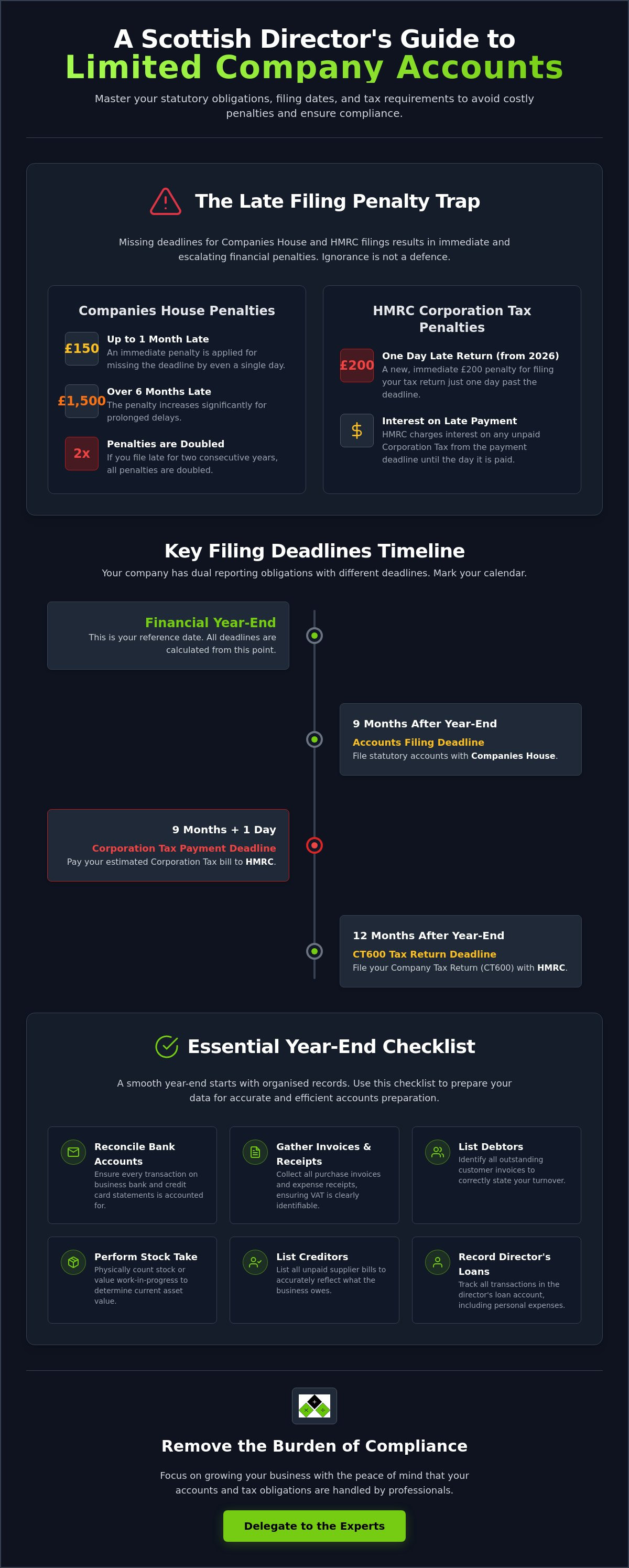
Missing a deadline is an expensive mistake that saps resources from your business. For Companies House, you must file your accounts within nine months of your financial year-end. If you're up to one month late, you'll face an immediate £150 penalty. This figure escalates quickly, reaching £1,500 if you're more than six months overdue. If you're late for two consecutive years, these penalties are doubled, creating a significant financial burden.
HMRC follows a different timeline that often catches directors off guard. While you have 12 months after your accounting period ends to file your CT600 tax return, the deadline to pay your Corporation Tax is actually nine months and one day. As of April 2026, being just one day late with your return triggers a £200 fine. Staying ahead of these dates isn't just about avoiding fees; it's about maintaining the professional reputation of your Scottish business.
The Essential Year-End Checklist for Scottish Directors
Approaching your financial year-end doesn't have to be a source of seasonal stress. When preparing your limited company accounts Scotland, the quality of your year-end data dictates the smoothness of the entire process. Order and precision are your best allies here; they transform a mountain of paperwork into a clear, manageable roadmap. By following a structured approach, you ensure that your statutory filings are accurate and your tax liability is calculated fairly.
Your first priority should be a full reconciliation of all bank accounts and credit cards. Every transaction must be accounted for up to the final second of your financial year. If your software balance doesn't mirror your bank statement, your accounts are built on shaky ground. Beyond the bank, you must gather every purchase invoice and expense receipt. For VAT-registered businesses, ensuring that VAT is clearly identifiable on every document is non-negotiable if you wish to reclaim those costs. You should also take the time to:
Identify all outstanding customer invoices (debtors) to ensure your turnover is correctly stated.
List all unpaid supplier bills (creditors) to accurately reflect what the business still owes.
Perform a physical stock take or value any work-in-progress to determine the value of your current assets.
Record all director loan account transactions, including personal expenses paid through the business account, to avoid complicated tax implications later.
Maintaining a clear trail for your limited company accounts Scotland ensures that when your accountant begins their review, there are no hidden surprises. If you find the volume of paperwork is pulling you away from your core business, seeking professional accounts preparation can provide the stability you need to focus on growth.
Preparing Your Bookkeeping for Review
Before handing over your records, verify that every transaction is categorised correctly within your accounting software. This isn't just about tidiness; it's a legal necessity under Making Tax Digital (MTD) regulations for VAT-registered firms. Digital record-keeping is now the standard for Filing company accounts with Companies House and HMRC. Utilising professional bookkeeping services simplifies this step, ensuring your data is "accountant-ready" and compliant with the latest digital standards.
Payroll and CIS Reconciliation
If you employ staff or operate within the construction sector, your year-end requirements extend to payroll and CIS. You must verify that your final Real Time Information (RTI) submissions align perfectly with your annual payroll records. For those in construction, ensuring CIS deductions are correctly recorded is vital to prevent overpaying tax. Don't forget to check for any benefits-in-kind, such as company cars or health insurance, which must be reported on P11D forms to keep your director responsibilities fully met.
Deciphering Reporting Frameworks: FRS 102 vs FRS 105
Choosing how to present your business to the world shouldn't feel like a guessing game. While the technical names—FRS 102 and FRS 105—might sound daunting, they simply represent different levels of detail in your financial reporting. For many directors managing limited company accounts Scotland, the choice depends on the size of the business and who needs to see the numbers. It's a decision that balances the desire for simplicity with the need for professional transparency.
FRS 105: The Micro-Entity Standard
For the smallest businesses, FRS 105 offers a streamlined path. To qualify for this simplified reporting for periods beginning on or after 6 April 2025, your company must meet at least two of the following criteria: a turnover of no more than £1 million, a balance sheet total of no more than £500,000, and an average of 10 employees or fewer. The primary benefit is a significantly reduced administrative burden. You'll provide fewer disclosures and a much simpler balance sheet; this is ideal if you're focused on day-to-day operations rather than complex financial structures.
However, this simplicity comes with a trade-off. Because FRS 105 accounts provide very little detail, they may not satisfy a bank manager considering a loan application or a potential investor looking for deep insights. If you plan to seek external funding or want to demonstrate a higher level of financial maturity, the "micro" route might actually hinder your progress. It's about deciding whether the time saved on filing is worth the potential loss of detail for external stakeholders.
FRS 102 Section 1A: For Growing Small Businesses
Once your business outgrows these micro-limits—perhaps reaching a turnover up to £15 million or a balance sheet of £7.5 million—you'll likely move to FRS 102 Section 1A. This framework is designed for small companies that need more robust reporting but aren't yet large enough to require full, complex accounts. It requires more detailed notes and a comprehensive profit and loss format. Whilst it takes more time to prepare, it presents a more professional image to potential partners and lenders.
Your choice of framework directly affects what appears on the public record at Companies House. Micro-entities can "fillet" their accounts, meaning they only submit the balance sheet for public view, keeping their profit figures private. Larger small companies must share more. It's a delicate balance between privacy and professional transparency. Understanding these rules is a core part of mastering Corporation Tax rules for Scottish companies, as your accounting framework provides the foundation for your tax calculations and your overall compliance strategy.
Scottish Tax Nuances and Local Compliance
While Corporation Tax remains a UK-wide obligation with rates ranging from 19% to 25% for the 2026/27 financial year, the personal tax implications for directors in Scotland are entirely distinct. Managing limited company accounts Scotland requires a nuanced understanding of how the Scottish Parliament's devolved powers affect your overall financial strategy. It is not enough to simply report your company's profit; you must also consider how that profit is extracted in a way that respects the unique Scottish tax landscape. This regional variance means that a generic UK approach often leads to missed opportunities or unexpected personal tax bills.
Director Remuneration in Scotland
Optimising your salary versus dividend split is a delicate task that becomes more complex north of the border. Unlike the rest of the UK, Scotland utilises a six-band income tax system that can significantly alter your take-home pay. The threshold where you move from the basic rate to the intermediate or higher rates often occurs sooner than it does for your counterparts in England or Wales. This means the "sweet spot" for a director's salary must be calculated with precision to avoid falling into a higher tax bracket prematurely. The Scottish Budget frequently introduces subtle shifts in these bands, making annual reviews of your remuneration strategy essential. Scottish tax bands differ from the rest of the UK by featuring six distinct tiers and lower thresholds for higher-rate tax, which directly influences the most tax-efficient salary level for directors.
The Value of Local Renfrewshire Expertise
There is a unique sense of relief that comes from partnering with a "trusted guide" who truly understands the local economic climate. For businesses in Glasgow or Paisley, proximity to our Linwood office allows for face-to-face tax advice sessions that go far beyond simple digital correspondence. We understand the regional grants available through Scottish Enterprise or local councils, ensuring these are correctly reflected in your limited company accounts Scotland. Supporting the local economy whilst maintaining meticulous compliance creates a stabilizing force for your business.
This local focus extends deep into the Western Isles business landscape, where remote enterprises face specific challenges such as higher logistical costs or unique regional development funding. Whether you are operating in the heart of Renfrewshire or out in Stornoway, we bridge the geographical gap by combining digital efficiency with a deep-rooted understanding of Highland and Island economic nuances. If you want to ensure your business is fully optimized for the Scottish market, contact our expert team today for a tailored consultation.
Streamlining Your Accounts with McCreath Accountancy
Managing limited company accounts Scotland shouldn't feel like a constant battle against deadlines and dense technical jargon. At McCreath Accountancy, we act as your trusted guide, taking the heavy lifting of compliance off your shoulders so you can breathe easier. Our approach to accounts preparation is never a generic, one-size-fits-all exercise. Instead, we tailor our service to reflect the unique nature of your business, ensuring that every entry and disclosure accurately represents your hard work whilst meeting the strict standards of Companies House and HMRC.
We believe in a cohesive financial strategy where nothing is left to chance. By integrating your payroll, VAT, and CIS requirements into a single, unified workflow, we remove the fragmentation that often leads to errors or missed tax-saving opportunities. This holistic view ensures that your business remains a stabilising force in your life, providing the order and organisation you need to thrive. If you are currently feeling underserved by your current provider, our transition process is designed to be effortless. We handle the professional clearance and data transfer, making the switch to a Scottish-based expert entirely stress-free.
Beyond Filing: Strategic Business Support
Your year-end accounts are more than just a statutory requirement; they are a powerful tool for future planning. We use the insights gained during the preparation process to help you identify growth opportunities and potential efficiencies. With regular check-ins and a methodical communication rhythm, we ensure you are always prepared for the next deadline long before it arrives. This personalised service allows you to reclaim your time and focus on what truly matters: your core passions and the people who depend on your business's success. By delegating these professional requirements to a dependable partner, you gain the freedom to lead your company without the weight of administrative anxiety.
Take the Next Step Toward Peace of Mind
Reclaiming your peace of mind starts with a simple conversation. Whether you prefer a face-to-face consultation at our Linwood office or a session in Stornoway, we are here to support you with meticulous care. Given the increased penalties introduced in 2026, including the immediate £200 fine for late HMRC filings, there has never been a better time to organise your limited company accounts Scotland and secure your business's future. You don't have to navigate the complexities of Scottish tax law alone. Let us take the burden of statutory filing away, allowing you to move forward with confidence, stability, and clarity.
Securing the Financial Future of Your Scottish Business
Mastering your limited company accounts Scotland is about more than simply avoiding the escalating penalties from Companies House or the immediate HMRC fines. It's about building a foundation of financial clarity that allows you to lead your business with confidence. By choosing the right reporting framework and navigating the specific Scottish tax bands with precision, you transform a yearly burden into a strategic asset for growth.
Since 2020, we've served as a stabilising force for directors across Renfrewshire and the Western Isles. Whether you're navigating complex CIS requirements or simply want to reclaim your evenings, our expert team is here to take on the heavy lifting. We invite you to contact McCreath Accountancy today for a stress-free approach to your limited company accounts. You've built your business through passion and hard work; let us provide the meticulous care your statutory filings deserve. You don't have to carry the weight of compliance alone.
Frequently Asked Questions
Do I need to file accounts if my Scottish limited company is dormant?
Yes, you must still file annual accounts and a confirmation statement with Companies House even if your business hasn't traded during the year. HMRC usually doesn't require a tax return once they've been formally notified of your dormant status, but you must keep them informed to avoid unnecessary queries. Failing to file these documents on time can lead to the same automatic penalties as an active company, so it's vital to maintain your filing schedule.
What is the difference between a tax return and statutory accounts?
Statutory accounts are a public record of your company's financial activity over the year, whereas a tax return is a private document used by HMRC to calculate your Corporation Tax. You use the figures prepared in your accounts to complete the CT600 tax return. Whilst they are closely related, they serve different purposes; one informs the public and shareholders about business health, whilst the other fulfills your specific fiscal obligations to the state.
Can I change my company’s financial year-end date in Scotland?
You can change your company's financial year-end by notifying Companies House, provided you haven't already extended it within the last five years. Many directors choose to shorten their accounting period to align with the tax year or to simplify their bookkeeping during a quieter trading period. However, you cannot extend an accounting period beyond 18 months without specific permission, such as when a company is in administration or moving to a new group structure.
What records must I keep as a director of a limited company?
You must maintain all financial records, including bank statements, purchase invoices, sales receipts, and payroll data, for at least six years. This ensures you can provide evidence for your limited company accounts Scotland if HMRC conducts a compliance check or if there is a dispute regarding your tax position. Keeping digital copies is highly recommended to meet Making Tax Digital standards and to ensure your records remain legible and organised over time.
How much does an accountant charge for limited company accounts in Scotland?
Fees for preparing limited company accounts vary significantly based on the complexity of your business and the total volume of your annual transactions. Most professional firms in Scotland provide a bespoke quote after reviewing your current bookkeeping and specific compliance requirements. Investing in professional support often pays for itself through improved tax efficiencies and the total removal of the administrative burden from your shoulders, allowing you to focus on growth.
What happens if I miss the Companies House filing deadline?
Missing the Companies House deadline results in an immediate, automatic penalty starting at £150 for being just one day late. As of 2026, these fines escalate to £1,500 if you're more than six months overdue, and they are doubled if you're late for two consecutive years. Beyond the financial cost, persistent late filing is a criminal offence that can lead to director disqualification or the company being struck off the register entirely.
Do I need an audit for my small limited company in Scotland?
Most small Scottish companies are exempt from a statutory audit if they meet at least two of the qualifying criteria regarding turnover, balance sheet total, and employee numbers. For accounting periods beginning on or after 6 April 2025, a company is generally exempt if its turnover is no more than £15 million and its balance sheet total is no more than £7.5 million. Unless your shareholders request an audit or your articles of association require it, it's usually unnecessary.
How does the Scottish Income Tax rate affect my dividends?
Scottish Income Tax rates apply only to your director's salary and other non-savings income, whereas dividends are taxed at the UK-wide dividend tax rates. This creates a unique planning opportunity for managing limited company accounts Scotland effectively. By carefully balancing your salary and dividend mix, you can navigate the six Scottish tax bands whilst utilising the UK dividend allowance to keep your personal tax liability as low as possible.


Comments