


Expert VAT Advice Scotland: Navigating Compliance for Small Businesses in 2026

Updated: Jul 8
What if your quarterly VAT return wasn't a source of dread, but a clear indicator of your business's financial health? For many small business owners across the country, the weight of HMRC regulations feels like a constant pressure that pulls focus away from their true passions. Whether you're nearing the £90,000 registration threshold or trying to apply the 5% reduced rate for summer hospitality attractions, seeking expert VAT advice Scotland can transform this administrative hurdle into a streamlined, manageable process. It's exhausting to worry about potential penalties or the looming 2026 expansion of Making Tax Digital while trying to run a team.
We understand that you'd rather spend your time on strategic growth than on hours of record-keeping. This guide promises to help you master the intricacies of Scottish tax, offering professional guidance designed to protect your cash flow and ensure total HMRC compliance. We'll explore the latest regulatory shifts, including the MTD requirements starting in April 2026; we'll also show you how a structured approach leads to a stress-free return process. By the end, you'll have a clear path forward to reclaim your time and operate with absolute peace of mind.
Table of Contents
Understanding VAT for Scottish Businesses in 2026
Value Added Tax, or VAT, is a consumption tax applied to the majority of goods and services within the UK. While it might feel like an additional layer of paperwork, it is helpful to view your business as a vital link in the national economy. In this system, Scottish businesses effectively act as "tax collectors" for HMRC, gathering VAT from customers and passing it on to the government. This responsibility requires precision, as the shift towards total digital transparency in 2026 means that HMRC has a clearer view of your records than ever before. Gaining a firm grasp of Understanding the UK VAT System is the first step toward removing the anxiety often associated with quarterly returns.
How VAT Works: Output vs. Input Tax
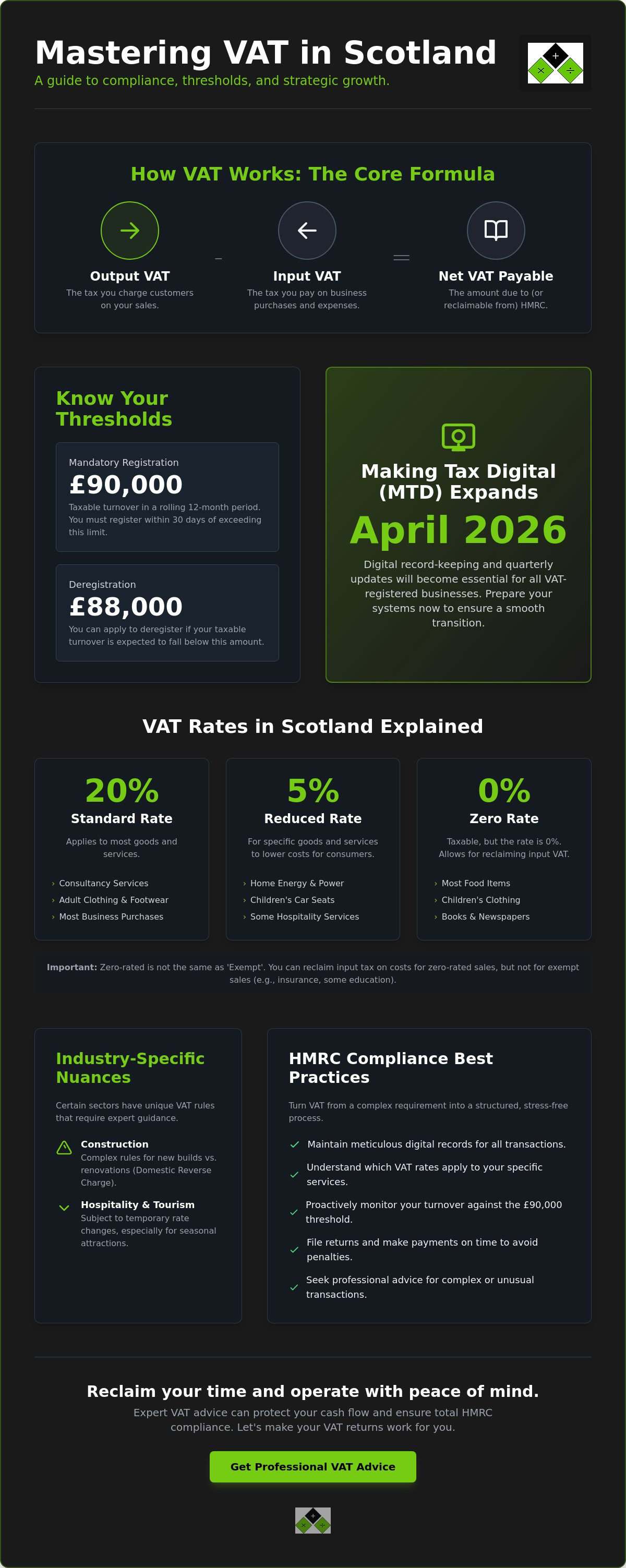
To manage your cash flow effectively, you need to distinguish between the tax you charge and the tax you pay. Output VAT is the amount you add to your invoices when you sell a product or service. Input VAT is the tax you pay to other businesses for your own supplies and expenses. For example, if an Edinburgh-based consultant invoices a client for £2,000, they would add £400 in output tax at the 20% standard rate. If that same consultant spends £240 on a new office chair, which includes £40 in VAT, they can generally reclaim that £40 as input tax. Net VAT is the final balance calculated by subtracting your total input tax from your total output tax, representing the amount due to or refundable from HMRC.
The Current VAT Landscape in Scotland
In 2026, staying compliant means knowing which rate applies to your specific offerings. Most items fall under the 20% standard rate, but certain goods, like children's car seats or home energy, attract a 5% reduced rate. Zero-rated items (0%), such as most food and children's clothes, are different from "exempt" items. This distinction is a frequent source of confusion for sole traders; whilst you don't charge VAT on either, you can reclaim input tax on expenses related to zero-rated sales, but you cannot do so for exempt sales like insurance or certain education services. Seeking professional VAT advice Scotland helps clarify these boundaries, especially during periods like the summer of 2026, when a temporary 5% rate applies to specific family leisure and hospitality services across the country.
When to Register: Thresholds, Benefits, and Voluntary Registration
Deciding when to register for VAT is a significant milestone for any growing enterprise. As of 2026, the official VAT registration thresholds mandate that you must register if your taxable turnover exceeds £90,000 over a rolling 12-month period. It's a common misconception that this limit applies to a fixed calendar or financial year. Instead, you must evaluate your total sales at the end of every single month. If the previous twelve months combined cross that threshold, the clock starts ticking. Alternatively, if your turnover begins to decline, the deregistration threshold for 2026 stands at £88,000, allowing you to step back from the system if your circumstances change.
You have a legal obligation to register within 30 days of the month-end in which you exceeded the limit. Failing to do so can lead to retrospective tax bills and penalties that put unnecessary strain on your business. This is where professional VAT advice Scotland becomes a stabilising force. By monitoring your turnover proactively, an expert can help you prepare for this transition well before it becomes a source of stress, ensuring your cash flow remains protected.
The Pros and Cons of Voluntary VAT Registration
You don't always have to wait for the £90,000 mark. Many startups in Renfrewshire choose voluntary registration to reclaim VAT on initial business expenses. This pre-registration input tax claim can be a massive boost to your early-stage finances. Being VAT-registered also gives your firm an air of established authority when pitching to larger corporate clients. However, it isn't without its burdens. You'll face increased record-keeping requirements, and if your customers aren't VAT-registered themselves, you may effectively be raising your prices by 20% to account for the tax.
VAT Registration Services in Scotland
Obtaining a VAT number involves a detailed application via the HMRC portal. Whilst you can handle this alone, many business owners in Glasgow and beyond prefer to appoint a professional accountant as their agent. This transfer of responsibility allows you to focus on your core passions while an expert manages the technicalities. Choosing the right effective date of registration is crucial; get it wrong, and you could miss out on reclaiming tax or end up with an unexpected bill. If you're unsure about the timing, seeking VAT advice Scotland ensures you choose an effective date that benefits your bottom line. Our team provides tailored VAT services to guide you through the entire application process with precision.
Making Tax Digital (MTD) and VAT Compliance in Scotland
By 2026, the transition to a fully digital tax system is complete for all VAT-registered entities in the UK. Relying on paper ledgers or basic spreadsheets isn't just inefficient; it's now a breach of HMRC's strict compliance standards. The core of Making Tax Digital for VAT in Scotland is the "digital link" requirement. This means that every piece of data must flow from your initial invoice through to the final return without any manual intervention or "copy-pasting." This level of automation might feel daunting at first, but it provides an incredible sense of security. You no longer have to worry about transcription errors or lost receipts when your records are digitally anchored. Obtaining professional VAT advice Scotland ensures that your digital systems are configured correctly from day one, protecting you from the risk of non-compliance penalties.
The shift towards total digital transparency in 2026 allows HMRC to monitor business activity with greater precision. For many small business owners, this is actually a blessing in disguise. When your records are digital, you gain a real-time view of your tax liabilities, meaning no more nasty surprises at the end of the quarter. It's about moving from a state of reactive panic to one of proactive control. By embracing these digital requirements, you're building a more resilient foundation for your business, allowing you to focus on your core passions while the software handles the heavy lifting of data organisation.
Choosing the Right VAT Accounting Software
For Scottish SMEs, the choice of software is critical. Platforms like Xero, QuickBooks, and Sage have become the industry standard for MTD compliance. These cloud-based options allow you to track your VAT liability in real time, which is essential for managing your cash flow. One of the most significant benefits is the use of automated "bank feeds." These feeds pull your transaction data directly from your bank account into your accounting software, which drastically reduces manual entry errors and ensures that your records are always up to date. If you're feeling overwhelmed by the technical setup, seeking VAT advice Scotland can help you choose the platform that best fits your specific industry needs.
The VAT Return Process: A Step-by-Step Guide
A structured approach to your quarterly returns can turn a stressful week into a simple afternoon task. Following these steps ensures your submission is accurate and timely:
Step 1: Reconciliation. Match all business transactions in your software with your bank statements to ensure every penny is accounted for.
Step 2: Review. Check your return for anomalies, such as duplicated invoices or missed input tax on business expenses that could save you money.
Step 3: Submission. Submit your return digitally to HMRC. This must be done through your MTD-compatible software before the deadline, which is usually one month and seven days after the period end.
Step 4: Settlement. Arrange your payment to HMRC or track your refund status directly through your software portal.
Industry-Specific VAT Nuances: Construction, Tourism, and Hospitality
Many small business owners tell us that VAT feels like it wasn't designed for their specific trade. Whether you're a joiner in Glasgow or a B&B owner on Skye, the standard rules often don't tell the whole story. Applying a one-size-fits-all approach is a common mistake that leads to overpaying tax or, worse, triggering an HMRC audit. Specialist VAT advice Scotland is essential when your business deals with mixed-rate supplies, such as a cafe that sells both hot food at the standard rate and cold takeaway snacks that are zero-rated. Without precise records, you risk losing a significant portion of your hard-earned profit to simple administrative errors or misunderstood regulations.
Every industry has its own rhythm and its own set of tax obligations. A local expert who understands the Scottish market can help you identify these nuances before they become a burden. It's about more than just staying legal; it's about optimizing your financial position so you can breathe easier. By tailoring your VAT strategy to your specific sector, you ensure that you aren't just a "tax collector" but a savvy business owner who keeps their finances in perfect order.
VAT for the Construction Sector: The Domestic Reverse Charge
In the construction sector, the Domestic Reverse Charge (DRC) has fundamentally changed how VAT is handled between subcontractors and main contractors. Instead of the subcontractor charging VAT and paying it to HMRC, the customer (the main contractor) accounts for it on their own return. This interaction with the Construction Industry Scheme (CIS) creates dual layers of compliance that can be incredibly confusing for those on the tools. McCreath Accountancy helps tradespeople across Glasgow navigate these dual layers, ensuring that your bookkeeping is accurate and your cash flow is protected from unexpected tax bills. We take the heavy lifting out of your quarterly reporting, leaving you free to focus on your latest project.
Tourism and Hospitality VAT in the Scottish Highlands and Islands
Tourism and hospitality businesses in the Scottish Highlands and Islands face their own set of hurdles. For B&Bs and holiday lets, the distinction between food services and accommodation is vital, especially given the temporary 5% rate for family leisure and attractions in the summer of 2026. If you operate as a tour operator in the Western Isles, you may need to apply the Tour Operators Margin Scheme (TOMS). This scheme allows you to pay VAT only on the "margin" or profit you make on certain travel services, rather than the full selling price. It's a complex area where professional guidance prevents costly errors. If you're struggling to untangle these threads, our team provides expert VAT services tailored to the unique needs of the Scottish tourism sector.
Navigating HMRC Inspections and Professional VAT Advice in Glasgow
The prospect of an HMRC inspection often triggers a sense of unease for small business owners. However, a routine visit is simply a process to verify that your business is paying and reclaiming the correct amount of tax. During a compliance check, HMRC will typically review your VAT records, calculations, and returns to ensure everything aligns with your digital submissions. If you've been consistent with your record-keeping as discussed in earlier sections, this process becomes much smoother. Triggers for these audits can vary, but they often include unusual refund claims or a history of late filings. Seeking expert VAT advice Scotland allows you to approach these inspections with confidence, knowing your records have been scrutinised by a professional eye before HMRC ever knocks on your door.
For organisations that require broader independent verification or global certification to meet international standards, you can check out International Associates Limited for their expert auditing and assurance services.
A proactive "VAT Health Check" is one of the most effective ways to identify and rectify errors early. It's far better to discover a missed input tax claim or a misapplied rate yourself than to have it flagged during a formal audit. For businesses in Renfrewshire or even as far as Stornoway, having a local partner who understands the specific economic pressures of your region is invaluable. We move beyond the city bubbles of the largest firms to provide accessible, high-level expertise to every corner of the country. This local focus ensures that your business receives the attention it deserves, regardless of your location.
Why Local VAT Advice Matters
There is a distinct advantage to working with an accountant who truly understands the Scottish market. Rather than dealing with a distant call centre or a generic automated bot, you receive personalised support tailored to your unique circumstances. For instance, we recently worked with a local retail business that had unknowingly miscalculated their zero-rated sales for several quarters. Through professional VAT planning and a thorough review, we were able to correct the error and negotiate with HMRC, saving the owner from a significant penalty that could have crippled their cash flow. This human-focused approach turns a cold regulatory requirement into a supportive, long-term partnership.
How McCreath Accountancy Can Help
Our role is to act as your stabilising force, taking on the heavy lifting so you can return to what you do best. From initial registration and MTD software setup to meticulous quarterly filings and strategic advisory, we provide a comprehensive suite of VAT services. We understand that behind every tax return is a person looking to reclaim their time and protect their business's future. By transferring the "VAT headache" to us, you gain the freedom to focus on your core passions with total peace of mind. Your compliance is our priority, allowing you to breathe easier and grow your business with confidence.
Reclaim Your Focus and Safeguard Your Business Future
Transitioning into 2026 requires more than just monitoring the £90,000 registration threshold. It's about mastering digital links for MTD and understanding how temporary rate changes or the domestic reverse charge impact your bottom line. By staying ahead of these shifts, you ensure that HMRC compliance becomes a background process rather than a constant distraction. Seeking professional VAT advice Scotland is the most effective way to protect your cash flow whilst ensuring every return is filed with absolute precision.
At McCreath Accountancy, we act as a dependable partner for businesses across Glasgow and the wider Scottish region. Our team combines deep insight into the Scottish business landscape with high-level expertise in cloud accounting and MTD compliance. Our empathetic approach is designed to remove the weight of tax administration from your shoulders, allowing you to breathe easier and focus on your core passions. Book your expert VAT consultation with McCreath Accountancy and take the first step towards a stress-free financial future. You've worked hard to build your business; let us help you protect it.
Frequently Asked Questions
What is the VAT registration threshold for Scottish businesses in 2026?
The mandatory VAT registration threshold for 2026 is £90,000. You must register if your taxable turnover exceeds this amount on a rolling 12-month basis, which means you should evaluate your sales at the end of every month. If your turnover begins to decline, the deregistration threshold is currently set at £88,000.
Can I reclaim VAT on expenses incurred before my business was registered?
Yes, you can generally reclaim VAT on goods purchased up to four years before your registration date and services bought up to six months before. The goods must still be in your possession and used for business purposes at the time you register. This "pre-registration input tax" claim can provide a significant financial boost during the early stages of your enterprise.
How often do I need to submit a VAT return in the UK?
Most businesses are required to submit a VAT return to HMRC every three months. This quarterly return, along with any payment due, must be settled within one month and seven days after the end of the accounting period. If you find these deadlines difficult to manage, seeking professional VAT advice Scotland can help you organise your records so that the process remains stress-free.
What is Making Tax Digital (MTD) and does it apply to me?
Making Tax Digital is an HMRC initiative that requires all VAT-registered businesses to maintain digital records and submit their returns using compatible software. It is mandatory for every VAT-registered entity in Scotland, regardless of turnover. The system is designed to create a "digital link" between your transactions and your tax return, which reduces the risk of manual errors and improves transparency.
What happens if I submit my VAT return late or pay HMRC late?
HMRC operates a points-based penalty system for late submissions and a separate, percentage-based penalty for late payments. Every late submission earns you a penalty point, and once you reach a specific threshold, you'll receive a £200 fine. Late payment penalties increase the longer the tax remains unpaid, so it's essential to settle your liabilities promptly to protect your cash flow.
Is there a difference between "Zero-Rated" and "Exempt" VAT?
The main difference is your ability to reclaim the VAT you've paid on your business expenses. Whilst you don't charge VAT on either category, zero-rated goods (0%) still allow you to reclaim input tax from your suppliers. Exempt services, such as certain insurance or finance products, do not permit you to reclaim any VAT, which can have a direct impact on your profit margins.
Do I need a separate bank account for my VAT payments?
While there is no legal requirement to have a separate account, we highly recommend it as a best practice for cash flow management. By setting aside the VAT you collect from customers into a dedicated savings account, you ensure the funds are available when your quarterly bill falls due. This simple step provides peace of mind and prevents you from accidentally spending money that belongs to HMRC.
Can an accountant in Glasgow handle VAT for my business in the Western Isles?
Yes, modern cloud accounting software makes it easy for an accountant to manage your VAT affairs regardless of where your business is located. Our practice is uniquely placed to support you, as we have offices in both Linwood and Stornoway. This allows us to provide expert VAT advice Scotland that combines high-level technical knowledge with a deep understanding of the local economic landscape in the islands.


Comments