


Accounts Preparation for Small Business in Scotland: A Comprehensive Guide

Updated: Jul 8
Have you ever spent a rare sunny Scottish weekend hunched over a kitchen table, drowning in receipts and worrying if you've correctly navigated the gap between Scottish and UK tax rates? For many entrepreneurs, the process of accounts preparation small business Scotland owners face feels less like financial management and more like a high-stakes guessing game against HMRC. It's completely natural to feel overwhelmed by the complexities of the 19% starter rate or the nuances of CIS compliance, especially when your true passion lies in serving your customers and building your brand.
You deserve the freedom to focus on your craft without the heavy weight of messy bookkeeping pulling you back. This comprehensive guide explores how professional accounts preparation transforms your financial records from a source of stress into a strategic roadmap for success. We'll walk you through the essential 2026/2027 tax thresholds, explain how to maintain total compliance, and show you how a local partner can help you reclaim your time. By the end, you will understand how to achieve total peace of mind and gain the financial clarity needed to scale your Scottish business with confidence.
Table of Contents
What is Accounts Preparation for Small Businesses in Scotland?
At its core, accounts preparation is the methodical process of gathering every financial transaction your company has made and distilling them into formal, structured reports. It is the bridge between your daily receipts and the high-level financial statements that tell the story of your business's health. For many owners, the reality of accounts preparation small business Scotland firms require involves moving away from a shoebox of invoices and toward a professional set of figures that both HMRC and potential investors can trust.
Whilst daily tracking relies on standard methods of bookkeeping to record what has been spent and earned, accounts preparation involves a higher level of professional analysis. It is not just about listing numbers; it's about ensuring those numbers are categorised correctly, adjusted for depreciation, and compliant with current Scottish tax regulations. This transition from raw data to a finished report provides a profound sense of relief. It replaces the anxiety of "not knowing" with the quiet confidence that your financial house is in order.
The Purpose of Statutory Accounts
Statutory accounts serve as a formal record of your financial performance over a specific twelve-month period. They are essential for several reasons:
Regulatory Compliance: You have a legal obligation to provide a true and fair view of your finances to HMRC and, if applicable, Companies House. This ensures you avoid the stress of late-filing penalties.
Financial Clarity: These reports allow you to see exactly where your profit is coming from and where your cash flow might be bottlenecked.
Access to Funding: Whether you are seeking a small business loan from a bank in Edinburgh or applying for Scottish Enterprise grants, lenders will demand professionally prepared accounts before releasing funds.
Sole Trader vs. Limited Company Requirements
The burden of reporting varies significantly depending on your business structure. Whether you operate as a sole trader in Glasgow or run a limited company in the Highlands, you must understand your specific path. Sole traders primarily focus on the Self-Assessment tax return, where accounts preparation ensures every allowable expense is claimed to reduce the final tax bill. It's about precision in a personal capacity.
For Limited Companies, the requirements are more stringent. You must file full statutory accounts with Companies House and a Company Tax Return with HMRC. Your "year-end" date is a critical milestone in your business calendar; it dictates your filing deadlines and payment dates. Professional preparation ensures these dates don't creep up on you, allowing you to plan your tax payments well in advance rather than facing a sudden, unexpected bill. This structured approach is the foundation of long-term stability for any small business in Scotland.
Navigating the Scottish Tax Landscape and Compliance
Operating a business in Scotland brings a unique set of financial responsibilities that differ from those in England or Wales. Whilst the personal allowance remains £12,570 across the UK for the 2026/27 tax year, the way your remaining income is taxed depends entirely on your postcode. This complexity is precisely why professional accounts preparation small business Scotland owners rely on is so vital; it ensures you aren't paying a penny more than necessary whilst staying firmly on the right side of HMRC.
A skilled accountant does more than just tally numbers. They act as a strategic partner, identifying legitimate tax-deductible expenses that many owners overlook. Whether it's capital allowances on equipment or specific costs related to working from home, these savings directly impact your bottom line. To keep your records accurate, you should regularly consult official guidance on Business tax and returns to stay ahead of changing thresholds and obligations.
Scottish Income Tax vs. UK Rates
For the 2026/2027 tax year, Scottish taxpayers navigate a six-tier system. This includes the 19% Starter Rate for income up to £15,397 and the 21% Intermediate Rate for earnings between £27,492 and £43,662. If your business is based in Renfrewshire or the Highlands, your Self-Assessment must reflect these specific bands. For directors of Scottish Limited Companies, the balance between taking a salary and receiving dividends becomes a delicate calculation, as dividend tax rates remain consistent across the UK whilst salary-based income tax follows the Scottish tiers. If you feel weighed down by these figures, our team can provide the Tax Advice you need to move forward with clarity.
Making Tax Digital (MTD) for Scottish SMEs
The transition to Making Tax Digital (MTD) has fundamentally changed how Scottish small businesses interact with HMRC. If your turnover exceeds the £90,000 VAT threshold, you're already required to keep digital records and submit quarterly returns through compatible software like Xero or QuickBooks. This shift from paper-based bookkeeping to real-time digital reporting can feel daunting, but it also offers a clearer view of your business's health. We bridge the gap between these digital tools and human expertise, ensuring your software is set up correctly to capture every transaction without the stress of manual entry. For those in the construction sector, this digital precision is equally critical for managing the Construction Industry Scheme (CIS), ensuring contractors and subcontractors in the Scottish trades remain fully compliant and avoid heavy penalties.
DIY vs. Professional Accounts Preparation: A Comparison
Many entrepreneurs start their journey by managing their own books to keep overheads low. It feels like a sensible way to maintain control in the early days. However, the reality of accounts preparation small business Scotland owners often discover is that "free" DIY accounting carries a heavy invisible price tag. Whilst digital tools are excellent for recording data, they cannot replace the strategic insight of a human expert who understands the nuances of the Scottish market.
Software-only solutions are brilliant at tallying figures, but they lack the intuition to spot a missed opportunity. A programme won't tell you if a specific expense should be treated as a capital allowance or if your current dividend strategy is inefficient under the 2026/27 Scottish tax bands. Professional oversight moves beyond simple data entry. It provides a level of scrutiny that ensures every figure is defensible, turning your annual accounts from a compliance chore into a powerful tool for business analysis.
The most common objection is that an accountant is an expense that a growing business cannot afford. In reality, the right partner often pays for themselves. By identifying legitimate tax reliefs you might have missed and preventing costly HMRC penalties, professional intervention transforms a simple fee into a strategic investment. With 90% of small businesses reporting that the cost of living is a threat to their growth in 2026, according to Credit Connect, ensuring your financial efficiency is no longer optional; it's a necessity for survival.
The Risks of Inaccurate Filing
Inaccurate filing is more than just a nuisance; it's a significant liability. HMRC's focus on compliance means that even honest mistakes in categorising expenses can trigger an enquiry. The stress of a formal tax investigation can be paralysing for a small business owner. Beyond the immediate threat of fines, messy or "good enough" accounts can actively hinder your growth. If you ever decide to sell your business or seek a capital grant from Scottish Enterprise, potential investors will demand a level of precision that DIY records rarely provide.
Evaluating the Value of Your Time
Think about your own hourly rate as a specialist in your field. If you spend five hours a month struggling with reconciliations or trying to understand VAT changes, what is that actually costing your business in lost revenue? For a business owner in the Western Isles or the Central Belt, the "Freedom Factor" is about more than just money. It's about reclaiming your weekends to spend with family or pursue your passions. Transferring the responsibility of accounts preparation allows you to step back into the role of a visionary leader rather than a data entry clerk.
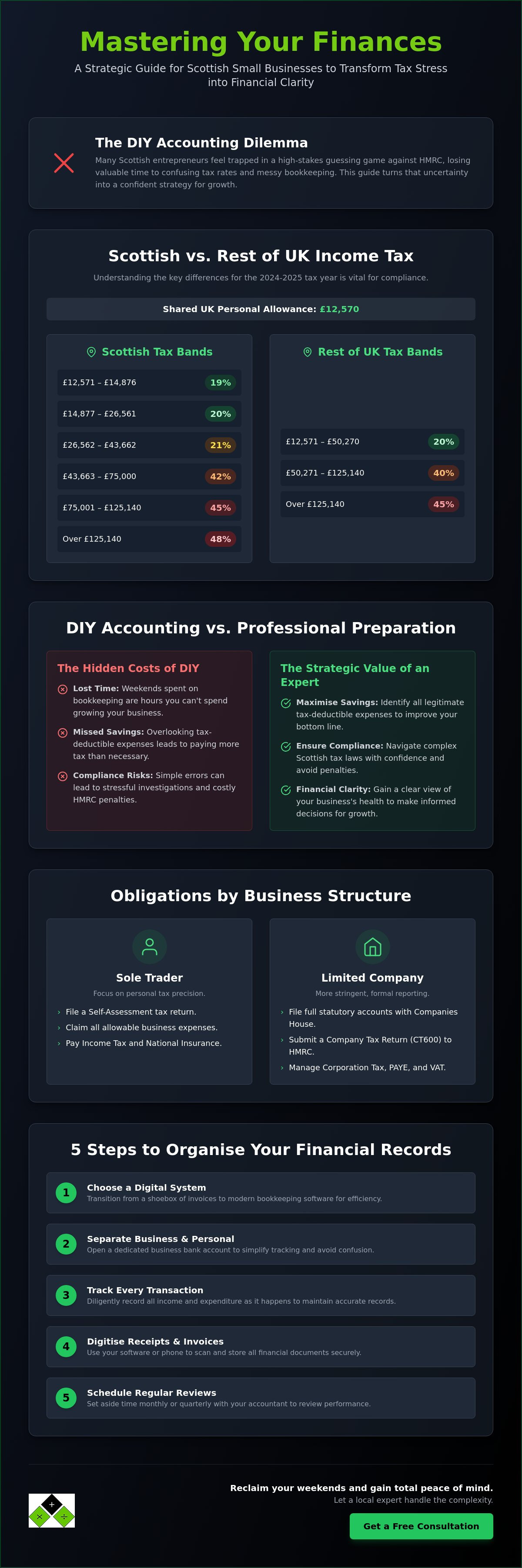
5 Steps to Organise Your Records for Your Accountant
Organising your financial life is an act of self-care for your business. When you approach accounts preparation small business Scotland with a structured plan, the entire process shifts from a burden to a breakthrough. By following these five steps, you'll ensure that your accountant can focus on saving you money rather than untangling messy data. It's about moving from a state of chaos to one of complete financial clarity.
Step 1: Reconcile your bank statements. Ensure every transaction on your business bank account matches an entry in your records. This is the foundation of an accurate year-end.
Step 2: Collate purchase invoices and sales receipts. Move away from paper where possible. Ideally, these should be stored digitally to comply with modern standards and ensure no VAT claim is lost.
Step 3: Organise payroll and CIS records. If you employ staff or work within the construction sector, having your monthly summaries and subcontractor statements ready is essential for compliance.
Step 4: Document asset purchases and mileage. Keep a clear log of any equipment bought during the year and a record of business journeys. These are often the most significant areas for tax relief.
Step 5: Schedule a discovery call. Use your year-end meeting to discuss your future goals. Your accounts should be a springboard for growth, not just a look back at the past.
Digital Record Keeping Tips
The era of "shoe-box accounting" has officially ended. In the age of Making Tax Digital, using mobile apps to snap photos of receipts on the go is the most efficient way to stay organised. It prevents the anxiety of lost paperwork and ensures your records are backed up in the cloud. We also strongly recommend maintaining a dedicated business bank account. Mixing personal and professional spending is the quickest way to create confusion during the accounts preparation process. A clean, separate account provides the "Freedom Factor" we all strive for.
What to Bring to Your First Meeting
Preparation is the key to a productive partnership. For our first session, please have your previous year’s accounts and your Unique Taxpayer Reference (UTR) ready. We'll also need to see identification to complete standard anti-money laundering checks, which is a professional requirement for all UK accountancy firms. Most importantly, bring a list of your biggest financial worries or questions. We're here to listen and provide a stabilizing force for your business. If you're ready to move from financial chaos to calm, book your discovery call with our team today and let us take the weight off your shoulders.
Why McCreath Accountancy is the Trusted Partner for Scottish SMEs
Local Expertise in Renfrewshire and the Western Isles
With offices in Linwood and Stornoway, we possess an intimate understanding of the unique challenges facing businesses in both the Central Belt and our island communities. A tradesperson in Glasgow has vastly different operational needs than a sole trader in the Western Isles, yet both require the same level of precision and reliability. We've seen first-hand how a local partner who understands the nuances of the Scottish market can transform a business's outlook. By being physically present in these communities, we offer a level of approachable, expert support that remote-only firms simply cannot match. We're here to ensure that local retail shops and skilled contractors alike have the financial clarity they need to thrive.
Beyond the Numbers: Strategic Support
Our approach goes beyond the simple recording of transactions. We don't just look at what happened in the past; we act as a trusted guide for your future business planning. By integrating your bookkeeping, payroll, and VAT services into a single, seamless workflow, we ensure that your financial data is always working for you. This holistic view allows us to provide strategic advice that helps you plan for the long term, whether you're looking to hire your first employee or invest in new equipment. We're committed to professional, transparent support that scales as your business grows. Ready to simplify your accounts? Contact McCreath Accountancy today.
Secure Your Financial Peace of Mind Today
Building a successful company requires your full attention, and your financial records should be a tool for growth rather than a source of anxiety. By investing in professional accounts preparation small business Scotland owners can finally step away from the kitchen table and back into the role of a visionary leader. You've seen how the right approach to Scottish tax rates and digital record-keeping can transform your operations from a state of chaos into one of absolute clarity.
At McCreath Accountancy, we are here to ensure you never have to face HMRC alone. With local offices in Linwood and Stornoway, our team offers empathetic, jargon-free support that is specifically tailored to the needs of Scottish SMEs and those in the construction sector. We specialise in CIS and small business tax, providing the expert oversight needed to protect your hard-earned profits. If you're ready to simplify your life and focus on your core passions, Book a Free Consultation with our Scottish Accounting Experts. Your journey toward a more stable and rewarding business future starts with a single conversation.
Frequently Asked Questions
What is the deadline for filing small business accounts in the UK?
For Limited Companies, your statutory accounts must be filed with Companies House within nine months of your financial year-end. If you are a sole trader, your online Self Assessment tax return must be submitted by 31 January following the end of the tax year. Failing to meet these dates can result in automatic penalties, which is why we prioritise timely preparation to give you total peace of mind.
Do I need an accountant if I use cloud accounting software like Xero?
Cloud software is an excellent tool for recording daily transactions, but it does not provide the professional scrutiny needed for full compliance. An accountant ensures your data is categorised correctly under Scottish tax law and identifies strategic tax-saving opportunities that software might miss. This human oversight is a critical part of the accounts preparation small business Scotland owners rely on for long-term stability.
How much does accounts preparation typically cost for a Scottish sole trader?
The investment for professional accounts preparation varies based on the complexity of your business and the volume of transactions you process. Whilst we don't provide a fixed industry-wide price, many clients find that the professional fees are comfortably offset by the tax efficiencies and time reclaimed. We focus on providing a transparent service that delivers genuine value and helps your business grow.
Can an accountant help me claim back CIS tax refunds?
Yes, we specialise in the Construction Industry Scheme and regularly help tradespeople recover overpaid tax. By meticulously reviewing your monthly CIS statements and business expenses, we ensure your year-end return accurately reflects your true liability. We handle the communication with HMRC on your behalf, removing the burden of the claims process so you can focus on your next project.
What is the difference between a bookkeeper and an accountant?
A bookkeeper manages the daily recording of financial data, such as sales invoices and bank reconciliations. An accountant takes this raw information to prepare statutory year-end reports, provide high-level Tax Advice, and offer strategic business planning. Think of the bookkeeper as the person who maintains the foundation and the accountant as the person who builds the house and plans for the future.
How do Scottish Income Tax rates differ from the rest of the UK for 2026/27?
Scotland operates a six-tier system for the 2026/2027 tax year, ranging from a 19% Starter Rate to a 48% Top Rate. These thresholds and percentages are distinct from the rest of the UK, meaning your accounts preparation small business Scotland filings must be handled with local expertise. We ensure your personal and business tax calculations reflect these specific Scottish bands to avoid any underpayment or overpayment.
Is it difficult to switch my business accounts to McCreath Accountancy?
Switching to our firm is a simple and seamless process that requires very little effort on your part. We manage the professional clearance with your previous accountant to ensure all your historical data is transferred securely and correctly. Our goal is to make the transition feel like a relief, providing you with a fresh start and a dependable partner from day one.
What records do I need to keep for HMRC as a small business?
You must keep a thorough record of all sales and income, business-related expenses, and any personal funds introduced to the business. This includes digital copies of all receipts, bank statements, and payroll records, which HMRC requires you to store for at least five years after the 31 January deadline. Organising these records digitally is the best way to ensure you are ready for the transition to Making Tax Digital.



Comments